
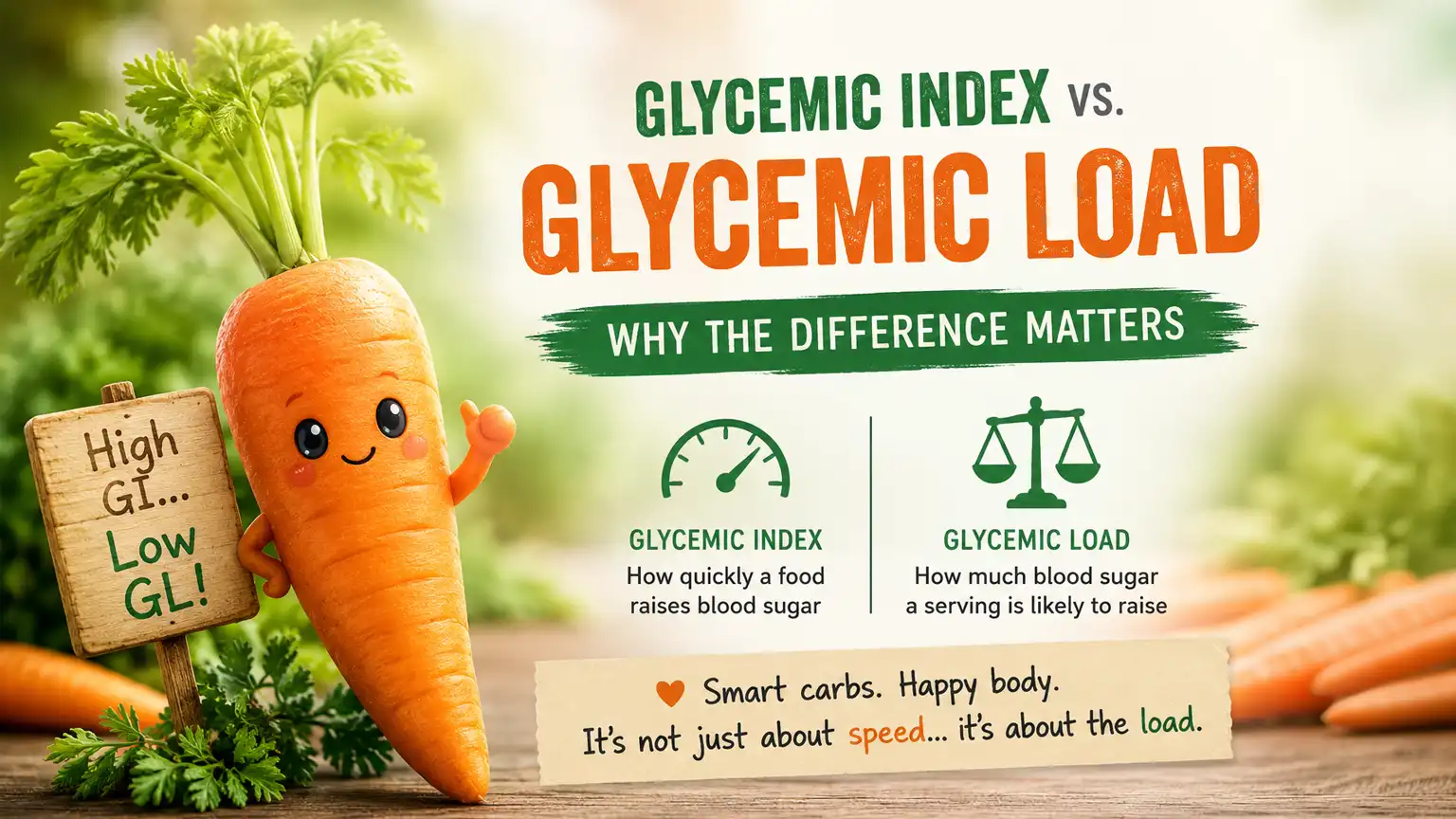
Glycemic Index vs. Glycemic Load: Why I Don’t Fear Carrots
A while back, someone told me they don’t eat carrots because they have a high glycemic index.
I had to laugh.
Carrots?
Nobody became diabetic because they ate too many carrots. The problem wasn’t the carrot. The problem was understanding what the glycemic index actually measures.
Why the Glycemic Index Exists
Before we can talk about glycemic load, it helps to understand why scientists created the glycemic index in the first place.
Researchers wanted a standardized way to compare different carbohydrate-containing foods.
To do that, volunteers ate enough of a single food to provide 50 grams of digestible carbohydrate. Researchers then measured how quickly that carbohydrate raised blood glucose compared to pure glucose.
That became the Glycemic Index (GI).
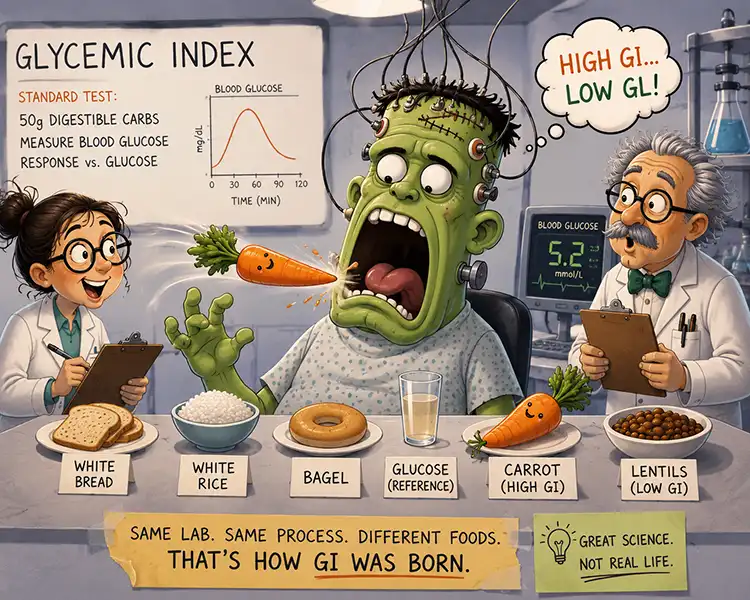
It’s an excellent scientific tool because every food is tested under the same conditions. But that’s also where the confusion begins. Nobody eats food under laboratory conditions:
- We eat meals.
- We eat servings.
- We eat carrots, not pounds of carrots.
The Carrot Test
Let’s go back to our carrot…
A carrot’s carbohydrates are absorbed fairly quickly. That’s why its glycemic index is relatively high.
But a carrot contains very little digestible carbohydrate. It’s mostly water and fiber.
So unless you’re planning to eat a whole grocery bag of carrots in one sitting, the glycemic load is very low.
That’s why fearing carrots simply because they have a high glycemic index misses the point.
What Changed My Thinking
Learning about glycemic load was a huge improvement over relying on the glycemic index alone. But eventually I realized I was asking an even bigger question.
My doctor and I were often looking at the same numbers. Blood glucose. A1c. The difference wasn’t the numbers. The difference was the question.
My doctor was trying to lower my blood sugar. I wanted to understand why my blood sugar was elevated in the first place.
That question led me to insulin resistance.
Looking Beyond Glucose
For years, my blood sugar wasn’t terrible. It wasn’t perfect. But it wasn’t the nightmare that eventually changed my life. What I couldn’t see was how hard my pancreas was working behind the scenes.
As insulin resistance increased, my body simply produced more insulin to keep my blood sugar looking reasonably normal. Eventually, that wasn’t enough. More medication. Higher doses. Another prescription.
Those were the signposts that made me stop and ask: If my blood sugar is controlled, why does it keep taking more medication to control it?
That question changed everything.
My Focus Shifted
I still pay attention to blood glucose. It’s an important measurement. But today, I’m just as interested in reducing the demand on my pancreas. That means eating foods that support better metabolic health rather than simply chasing a lower glucose reading.
Carrots aren’t the problem.
- Sugar-sweetened drinks.
- Refined carbohydrates.
- Ultra-processed foods.
Those are the foods I try to avoid.
The Takeaway
The glycemic index isn’t wrong. It’s simply incomplete.It tells you how fast digestible carbohydrates raise blood glucose. Glycemic load tells you how much impact a normal serving is likely to have.
For me, understanding that difference was an important step. But the biggest step came when I started asking a different question altogether.
Not…
“How do I lower my blood sugar?”
But…
“Why is my blood sugar elevated in the first place?”
That’s the question that ultimately changed my health.
Key Takeaways
Understanding GI and GL helped me make better food choices, but asking why my blood sugar was rising led me to focus on insulin resistance and metabolic health.
- Glycemic Index (GI) tells you how quickly digestible carbohydrates raise blood glucose.
- Glycemic Load (GL) tells you the likely blood sugar impact of a normal serving by considering both speed and the amount of digestible carbohydrate.
- A food can have a high GI and a low GL. Carrots are a classic example.
- GI was developed as a laboratory tool. GL was developed to make those results more useful in everyday eating.
- Understanding GI and GL helped me make better food choices, but asking why my blood sugar was rising led me to focus on insulin resistance and metabolic health.
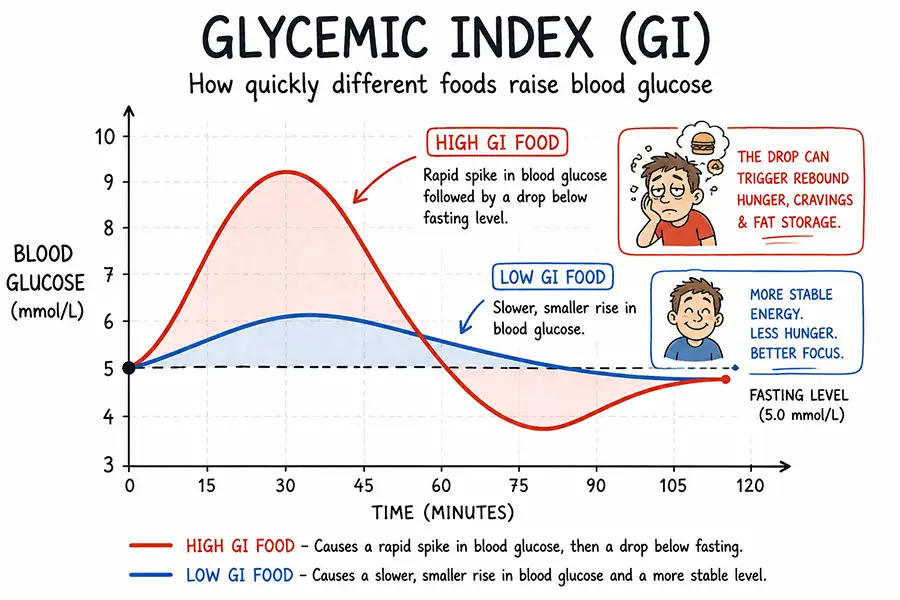
The Roller Coaster Effect
Or, Why you’re so darn hungry all the time.
High glycemic foods result in roller-coaster levels of blood glucose (sugar) and insulin. Low glycemic foods lead to a slower, smaller blood sugar rise and steadier insulin release from the pancreas.